For students
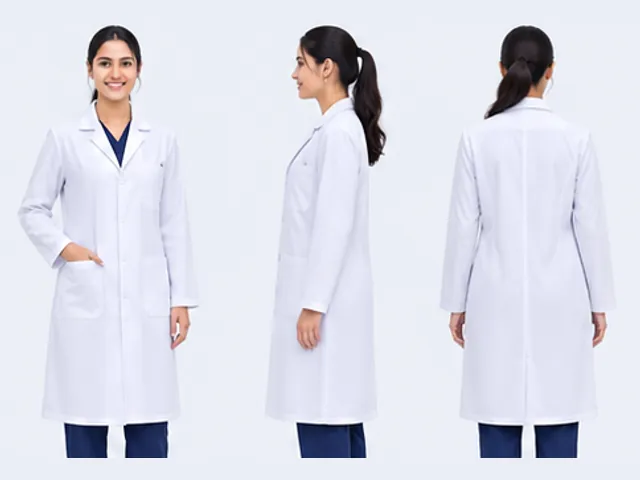
Coats for pharmacy and paramedical students

Pharmacy and paramedical courses, such as B.Pharm, D.Pharm, medical lab technology, radiography, optometry and others, are built around practical work. That means a coat is part of nearly every day: over your clothes in the lab, in the dispensary and later on hospital or community postings. Choosing the right one early saves discomfort and replacements later.
As with all student uniforms, your institution decides the colour, style and any logo. Use this guide to choose well within those rules.
Lab coat or longer coat?
Most students need a standard lab coat. Some courses or later clinical postings may ask for a longer coat.
| Coat | Typical use | Our option |
|---|---|---|
| Lab coat | Labs, practicals, dispensing | Lab coat, lighter poly-cotton, XS–XXL |
| Knee-length coat | Clinical postings, more formal settings | Doctor coat, poly-cotton twill, XS–3XL |
If your institution has not specified, a lab coat is usually the right first purchase.
What matters for practical work
Pharmacy and lab students handle reagents, glassware, powders and samples. A coat helps keep everyday spills and dust off your clothes. Remember:
- A standard coat is not specialist chemical or biological protection. Use the gloves, goggles and other equipment your lab provides, and follow its safety rules.
- Keep the coat buttoned during practicals.
- Roll or secure sleeves as your instructor advises, so they do not drag through spills or catch on equipment.
Getting the fit right
- Shoulders: room to reach across a bench without the coat pulling.
- Chest: buttons close easily over your clothes.
- Sleeves: reach your wrists with arms bent forward.
- Length: long enough to cover your lap when seated at a bench.
If between two sizes, choose the larger. Measure over the clothes you will wear underneath, and check the size chart.
Pockets and practical details
A coat with pockets for a pen, small notebook and calculator is handy in pharmacy labs. Radiography and imaging students may also need space for a dosimeter badge or similar item, as their department advises. Keep pockets light so the coat hangs straight.
How many coats
If you have practicals most days, two coats let one be washed while you wear the other. If labs are only a few times a week, one may be enough at first.
Keeping a white coat white
- Wash after every few uses, or straight away if splashed.
- Wash with whites only.
- Treat stains early; do not let them set in a hot dryer.
- Dry fully and iron warm.
Our post on caring for a white doctor coat covers this in more detail and applies to lab coats too.
Names and logos
Name embroidery is available on request and helps tell coats apart in a crowded lab. If your institution wants its logo on every coat, that is arranged as an institution order.
Wrapping up
Start with a well-fitting lab coat sized over your everyday clothes, add a second if your timetable is lab-heavy, and keep it clean from the first week. Measure yourself, then order your lab coat in the right size.