For doctors
Doctor coat length: knee or hip?
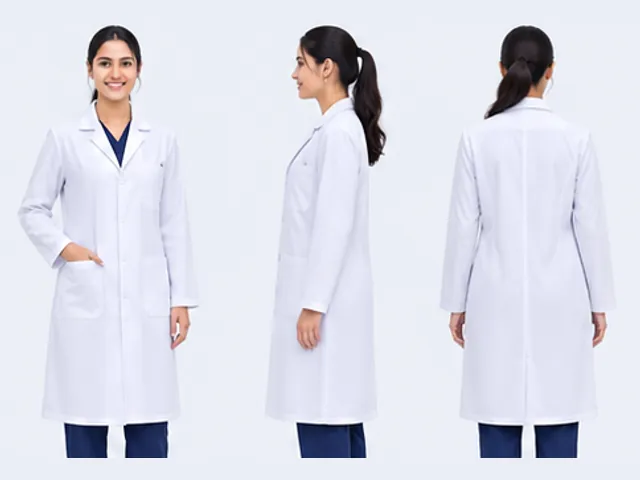
Two doctors can walk down the same corridor in white coats that look nothing alike. One wears a long coat that reaches the knee. The other wears a short jacket-style coat that stops at the hip. Both are doctors’ coats, and both are common in Kerala hospitals.
Length is the first choice to make when buying a coat, and it changes how the coat feels to wear more than most people expect.
The knee-length coat
The knee-length coat is the traditional doctor’s coat. It falls past the hips to around the knee.
What it does well:
- Covers more of your clothes. Shirts, trousers and the top of a saree or churidar stay protected from splashes and smudges.
- Looks formal. It is the coat most patients picture when they think of a doctor, and many colleges and hospitals expect it.
- Deeper, lower pockets. The extra length gives room for hip pockets that hold a notebook or stethoscope comfortably.
What to watch:
- It can feel warm in a humid ward or a non-air-conditioned OPD.
- It catches on chair arms and bed rails if it is too loose.
- Sitting and standing all day means the back creases quickly.
The hip-length coat
A hip-length coat stops around the hip bone, more like a jacket.
What it does well:
- Easier movement. Good for bending, kneeling at a bedside or moving quickly between rooms.
- Feels lighter. Less fabric means less heat in a Kerala summer.
- Stays out of the way when you sit at a desk or examine a patient on a low couch.
What to watch:
- Less coverage below the waist.
- Some institutions do not accept it for formal rounds or teaching sessions.
Which suits your work
| Setting | Usual choice |
|---|---|
| Ward rounds, OPD, teaching hospitals | Knee-length, for coverage and a formal look |
| Labs and practicals | Knee-length gives more protection to clothing |
| Quick-moving clinical roles | Some prefer hip-length for movement |
| Formal events, presentations | Knee-length |
Above all, your hospital or college decides. Many set a length, colour and sleeve style in their uniform policy, so check that before you buy.
What we make
Our doctor coat is the knee-length style, in poly-cotton twill, sizes XS to 3XL. We chose knee length because it is what most hospitals and colleges ask for, and because it gives the most coverage for daily use.
For students and technicians who want something lighter, the lab coat is made in a lighter poly-cotton, sizes XS to XXL.
Getting a long coat to sit right
A knee-length coat only looks good if the fit is right. A few checks:
- Hem: it should land around the knee when you stand straight. Much lower looks borrowed; much higher looks like a short coat.
- Shoulders: seams at the edge of your shoulders.
- Back: reach forward with the coat buttoned. If it pulls across your shoulder blades, go a size up.
- Over what you wear: try it over your usual shirt, kurta or saree blouse, not over a thin T-shirt.
If you are between two sizes, choose the larger one. A slightly roomy coat drapes well; a tight one creases and strains at the buttons.
Wrapping up
Knee-length gives coverage and a formal look; hip-length gives freedom of movement. Most hospitals and colleges lean towards knee length, which is why our coat is made that way. Check your institution’s rules, measure over your usual clothes, and use the size chart to find your size before ordering.